I am using Fedora KDE 41. I noticed that my swap space is seemingly located on dev/zram0 and it shows as a separate disk. This is weird because I have 2 disks and it is not shown as a part of either of them. How would I go about increasing my swap to 32 GiB, so I can hibernate my laptop, in case I have to?
Also, how is ZRAM different from swap space I would create my downsizing any of my “regular” partitions? Can I delete this zram and just create a 32 GiB partition with mountpoint as linuxswap? Would the end result be the same thing?
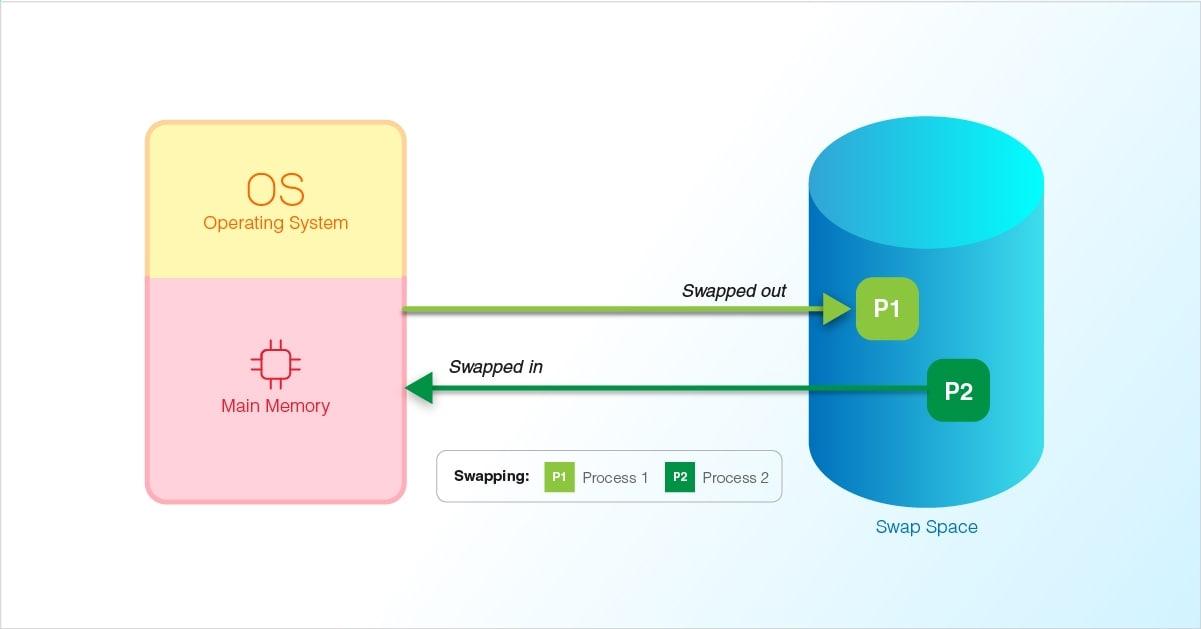
Swap space Is linux's backup memory area
Swap space Is the part of a Linux system that can temporarily hold memory pages when physical RAM is under pressure. It may be a disk partition, a swap file, or compressed RAM through zram. Swap space helps prevent abrupt out-of-memory failures, supports heavier multitasking, and can be required for hibernation, but it is slower than RAM and should be sized for the workload rather than treated as a performance upgrade.
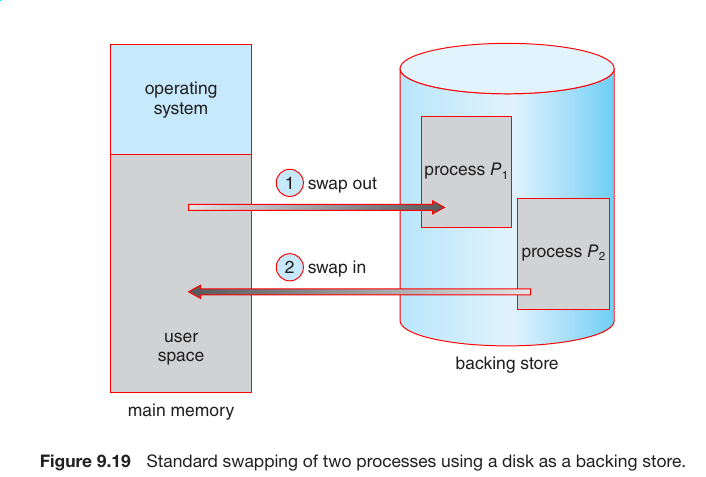
Swap space is easiest to understand as overflow capacity. When applications, browser tabs, virtual machines, databases, or desktop services demand more memory than the system can comfortably keep active, the kernel can move less-used memory pages away from active RAM. That movement gives busy processes more room, but it also introduces latency because reading from storage or decompressing zram is not the same as accessing normal memory.
Swap space is not a replacement for RAM. More RAM improves the amount of fast working memory available to programs, while swap mainly gives the kernel a place to park data that is not needed immediately. A system with too little RAM can still feel slow even with a large swap area because constant paging creates heavy input and output activity. The goal is stability and flexibility, not magic speed.
What is Swap space on Linux?
Swap space is a configured backing store for memory management. On traditional installations it is often a dedicated partition labeled for Linux swap, while many modern systems use a regular file such as
/swapfile
. Fedora and some other distributions may also configure zram, which appears as a block device like
/dev/zram0
even though it lives in RAM rather than on a physical drive.
Swap space can look confusing because the tools report it alongside disks, filesystems, and memory. A zram device may appear as a separate device in a partition tool, but it does not belong to an NVMe or SATA disk. It is a compressed memory device created by the system. A swap partition or swap file, by contrast, uses persistent storage on an SSD, hard drive, or other block device.
Swap space also has an identity that the kernel can detect. The
mkswap
command writes a swap signature to a partition or file, and
swapon
enables it for the running system. Persistent swap entries usually live in
/etc/fstab
, where they are activated at boot. These pieces work together so Linux knows which areas may safely hold temporary memory pages.
How does Swap space work during memory pressure?
Swap space becomes relevant when the kernel decides that active RAM needs relief. Linux tracks which pages are frequently used and which pages have been quiet. When memory pressure rises, inactive pages can be moved to Swap space so the system can keep hot application data, disk cache, and kernel operations moving. The exact behavior depends on kernel heuristics, workload, storage speed, and settings such as swappiness.
Swap space does not mean that Linux waits until RAM is completely full. The kernel may use swap earlier to keep a healthier balance between application memory and file cache. That is why seeing some swap usage is not automatically a problem. A small amount of Swap space activity can be normal, especially on desktops that stay running for days or servers that handle uneven workloads.
Swap space becomes a warning sign when usage is large and the system is constantly reading from and writing to it. That condition is often called thrashing. Applications may freeze for seconds, the desktop may lag, and command-line tasks may take much longer than expected. In that situation, adding Swap space may stop crashes, but reducing memory demand or adding RAM is usually the more durable fix.
When should you use Swap space?
Swap space is useful on laptops, desktops, workstations, virtual machines, and servers, but the reason varies by system. A small laptop may need Swap space to survive browser-heavy use. A workstation may need it as a buffer during occasional large builds, photo exports, or scientific workloads. A server may need carefully controlled swap so one memory spike does not immediately trigger the out-of-memory killer.
Swap space is especially important for hibernation. Suspend-to-disk writes the system memory image to persistent storage, then powers off. Because zram disappears when power is lost, it cannot store a hibernation image. For hibernation, the system generally needs a disk-backed swap partition or swap file that the boot process can find and resume from. The exact setup depends on the distribution, bootloader, encryption, and initramfs configuration.
Swap space can also help with memory overcommit. Linux often lets programs reserve more memory than they immediately use, because many programs ask for large address ranges and only touch some of them. Swap gives the kernel more room to manage those promises. It does not remove the need to monitor memory, but it can make temporary spikes less disruptive.
How much Swap space do you need?
Swap space sizing depends on RAM, workload, storage, and whether hibernation matters. Old rules said swap should be twice the size of RAM, but that advice is too broad for modern machines. A system with 4 GB of RAM may benefit from several gigabytes of swap, while a system with 64 GB of RAM may only need modest swap unless it hibernates or runs very large jobs.
Swap space for hibernation usually needs enough persistent capacity to hold the memory image, with some room for overhead. If a laptop has 32 GB of RAM and hibernation is a requirement, a 32 GB disk-backed swap area is a common starting point, but distribution documentation should be checked because compression, encryption, and resume settings can change the practical requirement. Zram can remain enabled for normal use while a lower-priority disk swap area exists for hibernation.
Swap space for everyday use can often be smaller. Many desktop users with 16 GB or 32 GB of RAM are comfortable with 4 GB to 8 GB of swap or a default zram configuration. Servers are different because predictable behavior matters more than desktop convenience. Database servers, container hosts, and latency-sensitive services should be sized and tuned according to application guidance, monitoring data, and recovery requirements.
| System situation | Common Swap space approach |
|---|---|
| Small desktop or laptop | Use zram or a modest swap file for smoother multitasking. |
| Hibernating laptop | Use persistent Swap space large enough for the resume image. |
| Large RAM workstation | Keep some swap for spikes, then monitor real usage. |
| Production server | Use conservative swap and alerts based on workload needs. |
Swap file, swap partition, or zram: which is better?
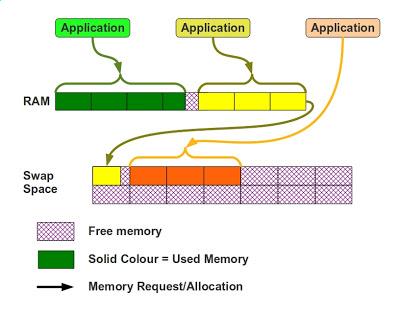
Swap space can be implemented in several ways, and each option has a place. A swap partition is simple, dedicated, and visible in disk layout tools. A swap file is easier to resize or remove because it lives inside an existing filesystem. Zram uses compressed memory and is usually faster than disk-backed swap, but it consumes RAM and cannot survive a power-off event.
Swap space on an SSD is far faster than swap on an old hard drive, but it is still slower than RAM. A swap file on a modern Linux filesystem is typically reliable when created correctly, although special cases such as copy-on-write filesystems may require distribution-specific steps. A partition can be a cleaner choice for hibernation because boot and resume tools have a stable block device to target.
Swap space through is attractive because compression can effectively store more inactive memory inside RAM. For light and moderate pressure it can feel responsive because the system avoids slower disk access. However, making zram extremely large is not always helpful. It can reduce the normal memory pool and still cannot provide persistent storage for hibernation.
How do you set up Swap space step by step?
Swap space setup should begin with inspection, not commands copied blindly. Check current memory and swap with tools such as
free -h
,
swapon --show
, and
lsblk
. These commands show whether swap is already active, whether it is backed by zram, a file, or a partition, and how much capacity is available. Understanding the current state reduces the chance of editing the wrong disk or duplicating a setup unnecessarily.
Swap space as a file is often the simplest path for a new user. The usual workflow is to create a file of the desired size, lock down its permissions, mark it with
mkswap
, enable it with
swapon
, and add an
/etc/fstab
entry if it should persist after reboot. The file should not be a normal data file, and permissions such as
0600
prevent other users from reading memory contents that may be written there.
Swap space as a partition requires free unpartitioned disk space or resizing an existing partition, which carries more risk. The process usually involves creating a partition with the Linux swap type, applying
mkswap
, activating it, and adding a stable reference such as a UUID to
/etc/fstab
. Before changing partitions, users should have backups and confirm the target device name because disk names like
/dev/nvme0n1
and
/dev/nvme1n1
can be easy to confuse.
- Inspect active Swap space and disk layout before making changes.
- Choose a swap file, partition, or zram based on the goal.
- Create the backing file or partition with the intended size.
-
Run
mkswapand enable it withswapon. - Add a persistent boot entry only after verifying the setup.
What are the benefits and limits of Swap space?
Swap space gives Linux more room to handle imperfect real-world workloads. It can prevent sudden application failures during short memory spikes, help background tasks survive while the user opens a large program, and make hibernation possible when configured on persistent storage. It also gives administrators a buffer while alerts, logs, and recovery tools capture what is happening.
Swap space has real limits. If an application needs active working memory and the machine lacks RAM, the system will still slow down. Large Swap space can hide a memory leak for longer, which may delay diagnosis. On storage-backed swap, heavy paging can increase disk writes, and on very slow storage it can make the system feel stuck. The best configuration is one that supports the workload without masking chronic memory shortage.
Swap space should also be considered from a privacy and security angle. Memory pages may contain fragments of documents, browser sessions, or application data. Full-disk encryption or encrypted swap can reduce exposure if a laptop is lost. Hibernation adds another layer because the memory image is intentionally written to storage. Users who rely on encrypted systems should confirm that their swap and resume configuration matches their threat model.
How is Swap space tuned and monitored?
Swap space tuning starts with observation. The
free
command gives a quick overview, while
vmstat
,
top
,
htop
, and system monitors can show whether the machine is actively paging. On servers, metrics for swap in, swap out, memory pressure, and disk latency are more useful than a single capacity number. A system with 2 GB of used swap may be healthy if it is quiet, but unhealthy if it is constantly churning.
Swap space behavior can be influenced by swappiness, a kernel setting that affects how readily Linux moves pages to swap. Lower values generally make the kernel prefer RAM longer, while higher values make swap more likely. There is no universal best value. Desktop distributions often choose defaults that balance responsiveness and cache use, and server tuning should be tested with representative traffic instead of guessed.
Swap space priority also matters when multiple swap areas exist. Linux can prefer zram first and fall back to disk-backed swap later, which is a practical arrangement for many laptops. Users who need hibernation can keep zram for day-to-day performance and configure persistent support through a partition or file. The important point is that the resume target must be available during boot.
What can go wrong with Swap space?
Swap space problems usually come from wrong assumptions, wrong devices, or oversized expectations. A user may create a large zram device expecting hibernation, only to learn that compressed RAM disappears at poweroff. Another user may add an incorrect
/etc/fstab
line and cause boot delays or failures. Partition changes can also damage data when the wrong disk is selected or a resize is interrupted.
Swap space can be removed safely only after it is deactivated and no longer referenced for boot. For a swap file, that means running
swapoff
, removing the persistent entry, and deleting the file after confirming it is not active. For a partition, the persistent entry should be removed first, then the swap device deactivated, and only then should partition tools be used. Careful sequencing matters because active swap is part of the running memory system.
Swap space should not be judged only by its size. The better question is whether the system remains responsive, avoids out-of-memory events, resumes correctly when hibernation is configured, and does not spend its day thrashing. With sensible sizing, monitoring, and a clear distinction between zram and persistent storage, Swap space becomes a practical Linux tool rather than a mystery device on the disk list.
Questions and Answers
What is Swap space in Linux used for?
Swap space is used as overflow memory when Linux needs to move inactive memory pages out of RAM. It can help prevent crashes during temporary memory spikes, support heavier multitasking, and provide persistent storage for hibernation when configured as a disk-backed swap file or partition. It is slower than RAM, so it improves stability more than speed.
Is Swap space the same as RAM?
Swap space is not the same as RAM. RAM is fast physical memory used directly by running programs, while swap is a secondary area used when memory pressure rises. Disk-backed swap is much slower than RAM, and zram is compressed memory inside RAM. More swap can reduce failures, but it does not replace having enough physical memory.
Should Swap space be a file or a partition?
A swap file is often easier to create, resize, and remove, which makes it convenient for many desktop and virtual machine setups. A swap partition is dedicated and can be simpler for some hibernation configurations. Both can work well when set up correctly. The best choice depends on distribution guidance, filesystem behavior, encryption, and whether hibernation is required.
Can zram be used as Swap space for hibernation?
Zram can be used as Swap space for normal memory pressure, but it cannot be used by itself for hibernation because it lives in RAM and disappears when the machine powers off. Hibernation needs persistent storage, usually a swap partition or properly configured swap file. Many systems use zram for daily responsiveness and disk-backed swap for resume support.
How much Swap space do I need?
Swap space sizing depends on RAM, workload, and hibernation needs. Small systems may benefit from several gigabytes, while systems with lots of RAM may only need modest swap for emergency headroom. If hibernation is required, persistent swap commonly needs to be large enough for the memory image. Monitor actual usage before assuming a larger swap area will improve performance.
Why does my system show Swap space on /dev/zram0?
A device such as /dev/zram0 is a compressed RAM block device. It may appear beside disks in system tools, but it is not stored on an SSD or hard drive. Linux can use it as Swap space because it behaves like a block device, yet the data remains in memory. That makes it fast, temporary, and unsuitable for hibernation.
Can too much Swap space cause problems?
Too much Swap space usually does not break a system by itself, but it can hide memory leaks and allow severe slowdowns to continue longer before an application fails. Very large zram settings can reduce normal available memory, and heavy disk-backed swapping can make a system feel unresponsive. Swap should be sized around real workload needs, not added without monitoring.